AI Translation Earbuds for Language Learning in 2026: Do They Accelerate Fluency or Make You Lazy?
AI Translation Earbuds for Language Learning in 2026: Do They Accelerate Fluency or Make You Lazy?
If you've been eyeing AI translation earbuds for language learning in 2026, you're not crazy. They're everywhere now, the demos are slick, and the promise is seductive: walk into any café, train station, meetup, or client call and understand everything in real time. For polyglots and aspiring polyglots, that sounds like cheating in the best possible way.
But here's the real question: Do AI translation earbuds for language learning actually improve your language ability, or do they quietly replace the struggle your brain needs to get better? The answer is not a neat yes or no. Used carelessly, they can absolutely turn you into a passive observer. Used strategically, they can reduce friction, create more real-world contact, and give you a bridge into situations that would otherwise be too intimidating.
We've already covered how AI-powered language learning tools are reshaping study, how AI conversation partners can expand speaking practice, and why spaced repetition still matters for retention. Translation earbuds sit somewhere in the middle of those worlds, part assistive technology, part crutch, part opportunity.
Let's cut through the marketing nonsense and figure out when they're genuinely useful.
What AI Translation Earbuds for Language Learning Actually Do Well
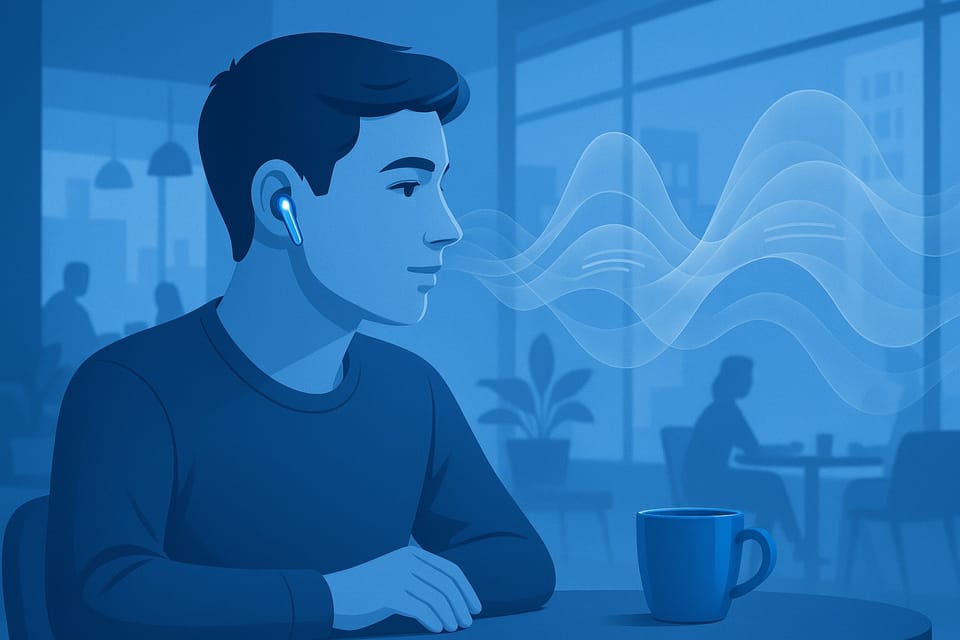
Modern translation earbuds are much better than the goofy tourist gadgets from a few years ago. Devices from companies like Google, Timekettle, and other hardware makers now combine speech recognition, live transcription, machine translation, and increasingly decent noise handling. In good conditions, they can do four things that matter for learners:
- reduce the panic of fast native speech
- help you survive high-friction situations, like transport or medical check-ins
- give you a transcript you can review later
- keep you in the conversation long enough to notice recurring phrases
That last point matters more than people realize. Language acquisition depends heavily on repeated exposure in meaningful contexts. Research on interaction-based learning consistently shows that comprehension improves when learners can stay engaged long enough to notice patterns, test hypotheses, and connect form with meaning. A good summary of this comes from work published in Frontiers in Psychology, where interaction, attention, and emotionally relevant context keep showing up as major pieces of successful acquisition.
So yes, if translation earbuds allow you to spend more time inside real conversations instead of bailing out after ten seconds, that's a legitimate win.
The Main Problem With AI Translation Earbuds for Language Learning
Here's where most learners screw it up: they use the earbuds to avoid processing the target language.
The second your brain learns that English will appear a beat later, it starts waiting for English. That's the whole danger. Instead of wrestling with ambiguity, predicting meaning, and tolerating uncertainty, all skills that drive comprehension growth, you become a spectator waiting for subtitles in your own head.
That is the exact opposite of what strong learners do.
Strong learners stay in the discomfort zone just long enough to force adaptation. That's the same logic behind comprehensible input and why micro-learning sessions work so well when they demand active recall instead of passive consumption.
If your earbuds become an always-on translator, they don't build fluency. They build dependency.
A useful rule: if you're understanding zero without the translation layer, your setup is too assistive. You want support, not replacement.
How to Use AI Translation Earbuds for Language Learning Without Sabotaging Comprehension
There is a smart way to use this tech, and it's surprisingly strict.
1. Use them for entry, not for the whole conversation
Start with the earbuds on when entering a difficult interaction. Once you've got the topic, the setting, and the speaker's rhythm, take the training wheels off whenever possible.
For example:
- use them to understand the first 60 seconds of a meetup conversation
- turn them off once the topic becomes clear
- turn them back on only if the conversation jumps or you get lost
That pattern forces your brain to keep working.
2. Prioritize transcript review over live translation comfort
The live translation is seductive, but the transcript is usually the gold mine. After the conversation, pull out three to seven phrases that actually mattered in context.
Then do something with them:
- say them aloud
- add them to your review system
- reuse them in a voice note or journal entry
- compare them with phrases from your shadowing practice
Live assistance disappears. Review creates memory.
3. Keep one ear in the target language at all times
If your device and setting allow it, avoid fully replacing the original audio. You need the rhythm, prosody, hesitation markers, filler words, and emotional tone. Those are not cosmetic details, they are part of language competence.
A learner who only consumes machine-smoothed meaning misses a ton of what makes real speech real.
4. Use them hardest in logistics, lightest in social settings
The best use cases are high-stakes, low-romance interactions:
- train stations
- customer service counters
- apartment bureaucracy
- airport disruptions
- medical intake forms
- landlord or bank conversations
In those situations, clarity matters more than purity.
The worst use case is leaving them on during a relaxed dinner or language exchange. That's where ambiguity, jokes, timing, and human messiness are the lesson.
When AI Translation Earbuds for Language Learning Are Actually Worth Buying
Let's be blunt. Most learners do not need these.
If you're still at the stage where you won't even do ten minutes of deliberate listening, buying fancy earbuds is like getting a carbon bike before learning how to pedal uphill. You don't have a technology problem. You have a consistency problem.
That said, translation earbuds can absolutely be worth it if you fit one of these profiles:
You live or travel in your target language environment
If you're constantly dealing with real-world input, the utility compounds fast. A device you use twice a month is a toy. A device you use three times a day becomes part of your learning system.
You study multiple languages
For people following a multiple-language strategy, translation earbuds can reduce setup friction when you're switching environments. You still need active production elsewhere, but they make spontaneous exposure easier.
You have high anxiety in spontaneous situations
Some learners know more than they can access under pressure. In that case, the earbuds can act as an emotional safety net rather than a comprehension substitute. Lower anxiety often means better participation, and better participation means more learning.
You review aggressively afterward
This is the dividing line. Learners who capture useful language and recycle it improve. Learners who just enjoy being rescued do not.
The Best Workflow for AI Translation Earbuds for Language Learning
If you want the short version, use this four-step system.
Step 1: Preview the situation
Before a likely difficult interaction, list likely phrases. If you're going to a pharmacy, expect dosage, symptoms, payment, and timing language. If you're going to a networking event, expect work, origin, neighborhood, and interest language.
Step 2: Use earbuds for comprehension support only
Keep translation on a short leash. Use it to stay in the room, not to outsource the entire room.
Step 3: Save five high-value phrases
No giant vocabulary dump. Five phrases max.
That keeps your review sane and aligned with environmental design: build a system you'll actually reuse.
Step 4: Turn those phrases into output within 24 hours
This is where acquisition starts sticking. Research on retrieval and memory consolidation keeps reaching the same conclusion: recall beats re-reading. If you want the phrase tomorrow, you need to retrieve it today.
Use those phrases in:
- a short spoken monologue
- a message to a tutor or language partner
- a three-sentence journal entry
- a shadowing loop with your own recorded voice
A Better Way to Judge AI Translation Earbuds for Language Learning
Don't ask, "Are they accurate?"
That's a consumer question.
Ask, "Do they increase the amount of real target-language contact I can tolerate without replacing the cognitive work of understanding?"
That's the learner's question.
An imperfect device can still be useful if it gets you into more real conversations. A highly accurate device can still be harmful if it trains you to wait for translated meaning.
That distinction is huge.
It also lines up with what broader second-language research has been telling us for years: feedback helps, support helps, context helps, but learners still need to notice, retrieve, and produce language themselves. Machines can lower friction. They cannot do the adaptation for you.
So, Should You Use AI Translation Earbuds for Language Learning?
Yeah, but with rules.
Use them as a bridge into difficult situations. Use them as a transcript generator. Use them as anxiety management. Use them when the alternative is avoiding the conversation entirely.
Do not use them as your permanent language layer. That's just outsourcing your growth.
The best learners in 2026 are not anti-tech and they're not blindly pro-tech either. They're selective. They know when to automate, when to struggle, and when to shut the gadget off and deal with the beautiful mess of real human speech.
If you've tried AI translation earbuds for language learning, did they make you braver, or did they make you lazier? That's the only question that really matters.