AI Voice Tutors for Language Learning in 2026: How to Practice Speaking Without Building Fake Fluency
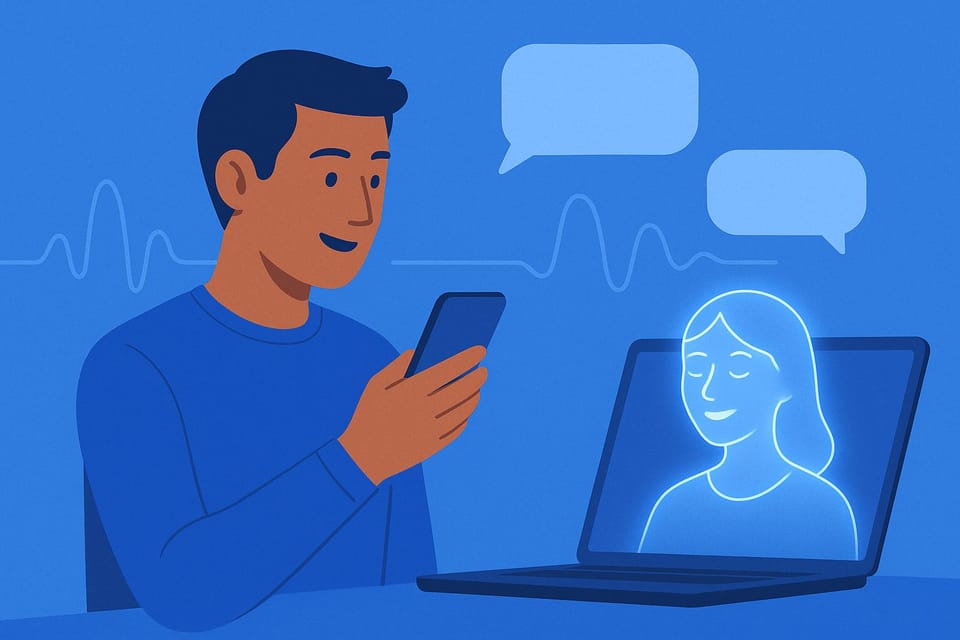
If you are looking at AI voice tutors for language learning in 2026, you are probably asking a smart question for a slightly dangerous reason. The smart part is obvious: voice tools have gotten good enough to give you actual speaking reps on demand. The dangerous part is that they are so smooth, so available, and so weirdly encouraging that they can make you feel more fluent than you really are.
Why AI voice tutors for language learning in 2026 are suddenly everywhere
The speech stack got dramatically better. Models now handle hesitation, accent variation, and follow-up questions fast enough that practice feels like conversation instead of a clunky drill.
That matters because the old bottleneck was not knowledge. It was speaking reps. Most learners knew they should talk more, but they did not have a tutor on standby at 7:12 a.m. before work or 11:40 p.m. after the kids were asleep.
Now they do. The danger is that these tools are so available, so forgiving, and so eager to keep the interaction pleasant that they can create a fake sense of competence. You feel smooth because the bot adapts to you. Humans usually do not.
The best AI voice tutor workflow in 2026 starts with hard speaking reps
If you want AI voice tutors for language learning in 2026 to work, build each session around production, not consumption.
A simple 20-minute loop
- Minute 1-3: set one scenario, like booking a doctor appointment or defending your opinion in a meeting.
- Minute 4-10: talk first, without notes, and let the AI push back.
- Minute 11-15: review mistakes, especially recurring pronunciation or grammar patterns.
- Minute 16-20: redo the same scenario with tighter, cleaner language.
That redo is the whole game. One clean second attempt beats ten sloppy first attempts.
What AI voice tutors still cannot do well
They still over-accommodate. They forgive weird phrasing because the model is trying to be useful. They rarely show the subtle social friction that real humans create when your tone is off, your timing is weird, or your answer is too long.
They also cannot fully reproduce messy group dynamics. Real language use includes interruptions, overlapping speech, bad audio, impatience, jokes, and regional slang. If your practice environment is too clean, your real-world transfer gets weaker.
This is why AI practice has to be paired with something like shadowing, retrieval, and human exposure. The tool is not the sport. It is the batting cage.
How to use AI voice tutors without building fake fluency
- Ask for interruptions: Tell the tool to cut you off, ask for clarification, and challenge vague answers.
- Use topic constraints: Hold conversations on work, travel logistics, family stories, and opinions, not just beginner scripts.
- Track repeated failures: Save the same 10 mistakes you keep making and attack them deliberately.
- Switch registers: Practice formal, casual, and service interactions so you do not sound like one weird robotic version of yourself.
A good session should expose weakness. If every session feels comfortable, you are probably rehearsing what you already know.
Where AI voice tutors fit into a real study system
The strongest setup is brutally simple: use AI for frequency, use content for input, and use humans for accountability. That means a few short AI sessions every week, a steady listening and reading routine, and some real conversation where there is social risk.
This stacks perfectly with AI pronunciation feedback tools, language shadowing, and a retrieval practice schedule. Different tools, different jobs.
The result is not perfect speech. It is faster recall, better rhythm, more confidence, and fewer deer-in-headlights moments when a real person answers unexpectedly.
Keyword research snapshot for AI voice tutors for language learning in 2026
The trend signal here is pretty obvious. Mainstream voice assistants got better, dedicated language tools started layering speech feedback into tutoring flows, and learners are now searching for combinations like AI voice tutor, pronunciation feedback, speaking practice with AI, and voice mode for language learning. The long-tail angle that matters is not generic tool reviews. It is outcome-driven intent: how do I practice speaking without fooling myself.
That is why this keyword works. It sits at the overlap of current tech curiosity and a real learner pain point. People do not just want to hear that voice AI exists. They want to know whether it helps them speak better, what workflow to use, and where the trap is. That makes the keyword commercially relevant, timely, and still specific enough to avoid sounding like recycled affiliate sludge.
How to turn AI voice tutors into deliberate speaking practice
The move is simple: stop treating the model like a magic teacher and start treating it like a configurable training environment. Tell it to simulate confusion, impatience, interruptions, and clarification requests. Ask it to stay in character. Ask it to stop over-praising weak answers. Ask it to track your repeated breakdowns over multiple sessions.
Most people never do this. They open the tool, ask for a conversation in Spanish or French, and drift through a pleasant exchange where the model does half the cognitive work for them. It is the equivalent of going to the gym and having somebody else lift the weight. You still showed up, sure, but you are not getting stronger.
A better setup is to create repeating drills around the kinds of speaking you actually need. Workplace updates. Travel logistics. Small talk. Opinions. Storytelling. Requests. Complaints. You want scenarios where precision, timing, and follow-up matter. When you rotate the same categories every week, you stop collecting random practice and start building usable range.
The biggest mistake learners make with AI voice tutors
They confuse recognition with recall. If the AI says something and you understand it, that feels good. If the AI gently nudges your weak reply toward a clearer one, that also feels good. But recognition is not the same as being able to produce language quickly under pressure. Recall is the real currency of speaking.
This is where voice tools should be paired with retrieval work. After a session, write down five phrases you failed to find quickly. Later that day, try to say them again in new contexts without looking. The next morning, reuse them in another live conversation with the model. That tiny loop turns feedback into memory instead of letting it evaporate as another nice little app experience.
What this means for serious learners in 2026
We are entering a phase where access is no longer the excuse. If you want speaking reps, you can get them. Cheaply. Often. At weird hours. In different difficulty modes. That is huge. But it also means the quality of your practice design matters more than ever. Abundance creates laziness if you do not impose standards.
The serious learner in 2026 will not be the person with the most subscriptions. It will be the person who uses voice AI to increase repetition, then ruthlessly checks transfer against reality. That means speaking with humans, dealing with uncertainty, and paying attention to what still breaks when the conversation is not built to be helpful.
Further reading and tools
- AI pronunciation feedback tools
- AI translation earbuds
- language shadowing
- retrieval practice schedule
- OpenAI voice capabilities
- Google Gemini Live
- Google real-time speech research
- Why exposure and feedback matter in second-language speech learning
- Skill acquisition theory in language learning
What would you trust more this week, another passive lesson, or ten minutes of brutally honest speaking practice with immediate feedback?