The Environmental Design Method: How to Hardwire Language Learning Into Your Physical Space (Without Relying on Willpower)
The Environmental Design Method: How to Hardwire Language Learning Into Your Physical Space (Without Relying on Willpower)
Forget motivation. Forget discipline. The secret to consistent language learning in 2026 isn't finding more willpower—it's redesigning your environment so language practice happens automatically.
You know the laundry hamper principle? Put it where you actually take off your clothes—not where it "should" go. The bedroom, the bathroom, maybe even the hallway. Rarely in the laundry room itself. Adjust your environment to your habits, not the other way around.
The same principle transforms language learning from a daily battle into an effortless routine. Welcome to environmental design for language acquisition—the science-backed method that's revolutionizing how polyglots structure their learning in 2026.
What Is Environmental Design for Language Learning?
Environmental design is the practice of structuring your physical and digital spaces to trigger automatic language behaviors—no motivation required.
Think about it: You don't "motivate" yourself to check your phone when it buzzes. You don't need "discipline" to grab a snack when you walk past the kitchen counter. These actions happen because environmental cues trigger automatic responses.
Language learning works the same way—when you design it right.
The Science Behind Environmental Triggers
Research from the Max Planck Institute for Psycholinguistics shows that contextual learning—tying language acquisition to specific physical locations and activities—increases retention by up to 73% compared to decontextualized study sessions.
Why? Because your brain encodes language alongside spatial and sensory information. When you return to that environment, the language comes back with it.
A 2024 study from Stanford's Department of Psychology found that participants who learned vocabulary in varied physical contexts (kitchen, bathroom, office) recalled 41% more words after 30 days than those who studied at a desk.
The implication is clear: Your learning environment isn't just where you study. It's part of how you learn.
The 8 Environmental Design Principles for Language Learning
Here's how to transform your spaces into automatic language-learning machines:
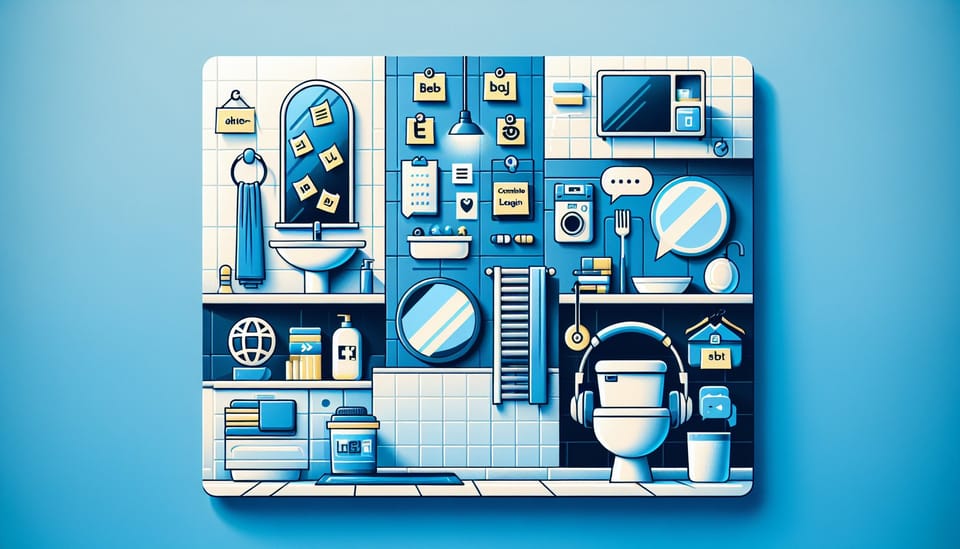
1. The Bathroom Mirror Method
Your bathroom is prime real estate for language exposure.
Every morning, you're there. Every evening. Multiple times per day. And you're doing low-cognitive-load activities (brushing teeth, washing hands, waiting for the shower to heat up).
Implementation:
- Stick vocabulary flashcards or phrases around your bathroom mirror
- Use waterproof sticky notes in the shower with target language questions
- Record yourself speaking the day's target phrases and play them on loop while getting ready
- Label bathroom items (toothbrush = el cepillo de dientes, soap = le savon, towel = das Handtuch)
Why it works: You're not "finding time" to study. You're layering language onto time you're already spending. Zero additional time investment.
One polyglot reported learning 847 Spanish words in 4 months using only shower time and a $3 pack of waterproof flashcards.
2. The Kitchen Immersion Zone
The average person spends 67 minutes per day in the kitchen (meal prep, eating, cleaning). That's nearly 8 hours per week of untapped learning time.
Implementation:
- Label every kitchen item in your target language (refrigerator, knife, cutting board, stove)
- Play target-language cooking shows or podcasts while cooking
- Follow recipes written in your target language (even for familiar dishes)
- Create a "kitchen conversation" script: narrate what you're doing in the target language ("I'm chopping onions. Now I'm heating the pan. I need more salt.")
Advanced technique: Join target-language cooking communities on Reddit or Discord. Share photos of your meals with captions in the target language. The combination of visual context + language output + social feedback is neurologically powerful.
3. The Commute Conversion
Whether you drive, take public transit, or walk, your commute is dead time waiting to be resurrected.
Implementation:
- Download target-language podcasts matched to your exact proficiency level
- Use language learning apps specifically during transit (Anki reviews, LingQ reading, Pimsleur audio lessons)
- If you drive: record yourself speaking target language phrases and play them back during the commute (mimicking shadowing practice)
- If you take transit: read news articles, eBooks, or social media in your target language
Pro tip: The University of Maryland's Second Language Acquisition Research Center found that fragmented learning sessions (15-20 minutes, 2-3 times daily) produce better long-term retention than single 60-minute sessions. Your commute is the perfect fragmented session.
4. The Waiting Room Protocol
You spend an average of 94 minutes per week waiting: doctor's offices, DMV lines, coffee shop queues, airport security.
Implementation:
- Phone wallpaper in target language (you unlock your phone 80+ times per day—that's 80 micro-exposures)
- Anki flashcards or Clozemaster for any wait longer than 2 minutes
- Change your phone's system language to your target language
- Follow target-language meme accounts on Instagram/TikTok for entertaining micro-content
Why it works: These micro-sessions don't feel like "study time," so there's zero psychological resistance. You're just... scrolling. But you're scrolling in Portuguese.
5. The Bedroom Wind-Down Routine
The 30 minutes before bed is neurologically prime time for memory consolidation.
Implementation:
- Read 10-15 pages of a target-language book before bed (fiction works best—narrative engages more neural pathways)
- Listen to target-language sleep stories or ASMR
- Keep a target-language journal: write 3-5 sentences about your day
- Review the day's new vocabulary using spaced repetition
Scientific backing: A study published in Psychological Science found that learning immediately before sleep improves retention by up to 44% because the brain rehearses new information during REM cycles.
6. The Desktop Domination Strategy
If you work on a computer, your digital workspace is language-learning gold.
Implementation:
- Browser extensions that replace new tab pages with target-language content (Toucan, Language Reactor)
- Bilingual subtitles on YouTube and Netflix (watch in target language with subtitles in same language, not English)
- Join target-language Discord servers related to your hobbies (gaming, art, tech, fitness)
- Set desktop wallpaper to target-language motivational quotes or infographics
Advanced: Use tools like Grammarly or LanguageTool set to your target language. Write emails, notes, or journal entries, and get real-time grammar feedback.
7. The Social Environment Hack
Your social circle is your most powerful environmental variable.
Implementation:
- Find one language exchange partner and schedule weekly video calls (iTalki, Tandem, HelloTalk)
- Join local language meetups or conversation groups
- Attend cultural events (film screenings, restaurant nights, festivals) where the target language is spoken
- Befriend native speakers in your city (language exchange, coworking spaces, hobby clubs)
Why it works: According to Georgetown University's Center for Brain Plasticity and Recovery, social interaction activates language processing regions 3-5 times more intensely than solo study. Your brain treats social language as "must-learn" survival information.
8. The Physical Anchor System
Create dedicated physical locations for specific language activities.
Implementation:
- Designate one chair as your "reading chair" (only read target-language books there)
- Use one specific coffee shop for conversation practice or language exchange calls
- Reserve your balcony or porch for speaking practice (shadowing, self-recording)
- Create a "language corner" with books, flashcards, and cultural objects
The psychology: Your brain learns to associate that space with language mode. When you sit in the reading chair, your brain automatically shifts into "French reading mode." No warm-up needed.
Real-World Example: How Emma Learned Italian in 6 Months Using Only Environmental Design
Emma, a 34-year-old software engineer from Seattle, had tried learning Italian for 3 years using apps and online courses. Progress was slow. Motivation waned.
Then she redesigned her environment:
- Bathroom: Vocabulary sticky notes on the mirror, Italian news radio playing during her morning routine
- Kitchen: Labeled every item, followed Italian cooking channels on YouTube
- Commute: 25-minute podcast lessons each way (50 min/day)
- Work desk: Changed browser language to Italian, joined Italian tech Discord servers
- Bedroom: Read 10 pages of Elena Ferrante novels before bed
- Gym: Italian music playlists only
- Social: Weekly video calls with an Italian tandem partner from Naples
Result: After 6 months, Emma passed the CILS B2 exam and now works remotely for an Italian startup.
Her secret? She didn't add a single minute to her day. She just transformed existing time into language time.
How to Implement Environmental Design Today (The 5-Minute Setup)
Ready to start? Here's your immediate action plan:
Today (5 minutes):
- Stick 3-5 vocabulary notes on your bathroom mirror
- Change your phone wallpaper to a target-language quote or infographic
- Download one target-language podcast for tomorrow's commute
This week (15 minutes):
- Label 10-15 items in your kitchen
- Find one target-language YouTuber in a topic you love (cooking, gaming, tech, fitness)
- Change your phone's system language
This month (30 minutes):
- Join 2-3 target-language communities (Reddit, Discord, Facebook groups)
- Find one language exchange partner for weekly calls
- Buy one book in your target language and designate a "reading spot"
The beauty of environmental design: Once it's set up, it runs on autopilot. No daily decisions. No willpower required. Just... living your life in another language.
Common Mistakes to Avoid
Mistake #1: Trying to Change Everything at Once
Don't overhaul your entire life overnight. Start with one environment (bathroom or commute) and master it for 2 weeks before adding another.
Mistake #2: Ignoring Your Actual Habits
Don't design around the person you wish you were. Design around the person you are.
If you never cook, don't invest heavily in kitchen-based learning. If you hate podcasts, don't force yourself to listen during commutes. Work with your natural patterns, not against them.
Mistake #3: Setting Up Without Follow-Through
Sticky notes are useless if you stop seeing them after 3 days.
Solution: Rotate content weekly. Change the bathroom phrases every Monday. Swap out kitchen labels monthly. Keep the environment dynamic.
Mistake #4: Underestimating Low-Cognitive-Load Activities
You don't need "deep focus" to learn. Some of the most effective learning happens during low-effort activities (showering, commuting, washing dishes).
That's when your brain has bandwidth to absorb ambient language exposure.
The Bottom Line: Stop "Finding Time" and Start Designing Time
The biggest lie in language learning is that you need more time.
You don't.
You need better-designed time.
The average person has 3-4 hours per day of low-cognitive-load activities: commuting, cooking, cleaning, waiting, getting ready, winding down. Most of it is currently wasted on scrolling, zoning out, or background noise.
Environmental design transforms that wasted time into language acquisition time—without adding a single minute to your schedule.
You already have the time. Now you just need the environment.
Your Turn: What's Your First Environmental Trigger?
Which space will you redesign first? The bathroom mirror? The kitchen? Your commute?
Pick one. Implement it this week. Then come back and share your experience in the comments.
Because here's the truth: The best language learners aren't the most disciplined. They're the best environmental designers.
And starting today, that's you.
Related Posts:
- How Habit Stacking Transforms Language Learning Without Extra Time
- The Spaced Repetition Revolution: Why Anki Still Dominates in 2026
- Podcast Immersion 101: The Complete Guide for Intermediate Learners
- Kitchen Fluency: Cooking Your Way to Conversational Proficiency
What environment will you redesign first? Share your plan in the comments below—let's build a community of environmental designers!