How to Think in a Foreign Language in 2026: A Bilingual Inner Speech Method That Makes Speaking Faster
How to Think in a Foreign Language in 2026: A Bilingual Inner Speech Method That Makes Speaking Faster
How to think in a foreign language is one of those goals almost every learner wants, but most advice stays vague: “stop translating” or “just immerse more.” That sounds nice, but it is not a method. In practice, people do not jump from full translation to effortless inner speech overnight. They move through stages. The fastest path is usually not forcing a fake “all target language, all the time” mindset, but building a bilingual inner speech system that gradually shifts more of your thoughts into the language you want to speak.
That matters because speaking speed is rarely blocked by grammar alone. More often, the problem is processing. You know the words, but your brain still runs the sentence through your first language before it lets you say anything. If you can shorten that loop, conversations feel lighter, faster, and less exhausting.
In this guide, I’ll break down a practical method for learning how to think in a foreign language: what it really means, the transition stages, the daily routines that make it happen, and the mistakes that slow people down.
What “thinking in the language” actually means
Let’s clear up the biggest misunderstanding first. Thinking in another language does not mean you suddenly narrate every thought like a novelist. It means more of your mental processing happens directly in the target language, without a full detour through your native one.
That can look like:
- seeing a dog and thinking the target-language word first
- planning a reply with simple chunks instead of translating a long English sentence
- hearing a question and answering it with a familiar pattern automatically
- using images, sensations, and context to support meaning instead of mentally subtitling everything
This is also why the CEFR framework treats fluency as more than vocabulary size. Real proficiency includes processing speed, flexibility, and the ability to use language for real-time communication, not just recall isolated words. If you want a clean proficiency reference, the CEFR overview is still the best starting point.
How to think in a foreign language: stop chasing the final stage too early
Search results for “how to think in a foreign language,” “how to think in a second language,” and “how long does it take to think in a new language” usually push the same core idea: do more inner monologue and reduce translation. That part is fine. The weak part is that many articles skip the transition.
Here is the more honest model:
- Stage 1: Native-language dominant. You understand bits of the target language, but you build meaning mostly through translation.
- Stage 2: Labeling. You can attach target-language words to objects, actions, places, and routines.
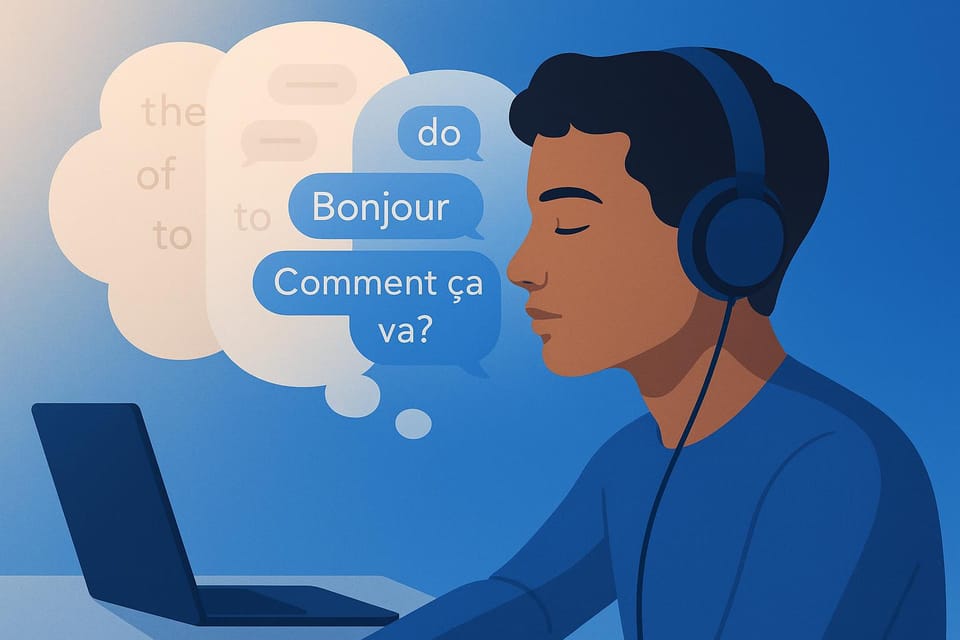
- Stage 3: Bilingual inner speech. You think partly in both languages, often using short target-language chunks inside native-language thought.
- Stage 4: Target-language default for familiar situations. Everyday reactions, descriptions, and simple plans start appearing directly in the target language.
- Stage 5: Flexible inner speech. You can think, plan, react, and self-correct mostly in the target language, especially in domains you know well.
The key point: Stage 3 is not failure. It is the bridge. If you skip it and try to force full target-language thought too early, you usually end up with broken, repetitive inner monologue and a lot of frustration.
How to think in a foreign language with the bilingual inner speech method
This method works because it matches how mental processing actually shifts. Instead of banning your first language, you use it strategically while increasing the amount of target-language thought every week.
Step 1: Build direct links between meaning and words
Your brain has to stop treating every word as a translation entry. A word should connect to an image, situation, action, or feeling first. That is why beginners benefit so much from high-quality input and repeated context. If you need a refresher on making input actually comprehensible, this guide on comprehensible input for beginners is worth using alongside this method.
Make this concrete:
- label objects around you with the target language in your head
- learn verbs with visual context, not isolated translation lists
- use example sentences, not word pairs alone
- check nuance in a monolingual source like the Cambridge Dictionary when possible
If you learn hungry only as “X = Y,” you’ll translate forever. If you learn it through situations, phrases, and recurring usage, recall gets much faster.
Step 2: Start with micro-thoughts, not full monologues
A lot of learners make this harder than it needs to be. Do not start by trying to narrate your philosophy of life in Italian. Start with tiny thoughts:
- Too expensive.
- I’m tired.
- Where is my phone?
- I need coffee.
- That was interesting.
These short, high-frequency thoughts matter because they come up all the time in real conversation. They also create the first feeling of direct access.
Step 3: Use bilingual chaining
This is the core of the method. Take a thought you would normally have in your native language and replace part of it with target-language chunks.
Example:
- “I need to leave now or I’ll be late.”
- becomes: “I need to leave now… no, actually: I’m late… I have to go now.”
You are not trying to produce perfect prose. You are training faster access to usable patterns. Over time, the native-language scaffolding shrinks and the target-language chunks expand.
That is the difference between vague “think in the language” advice and an operational routine. You build chunk by chunk, situation by situation.
Step 4: Think in scenes you repeat often
Thinking becomes easier when the context is predictable. Start with scenes that recur in your life:
- getting ready in the morning
- commuting or walking
- shopping
- answering basic social questions
- talking about work, school, food, sleep, weather, and plans
Prepare language for those scenes in advance. That is one reason sentence mining works so well: you collect expressions you actually want to reuse, instead of memorizing random textbook lines.
Step 5: Add sound to inner speech
Thinking is not purely abstract. For many learners, inner speech improves once pronunciation becomes more stable. If a word feels fuzzy in your mouth, it often stays fuzzy in your head too.
Use tools like Forvo for pronunciation checks and YouGlish for real examples in context. Then repeat the phrases aloud or quietly. Shadowing is especially useful here because it tightens the link between hearing, producing, and mentally retrieving language. If you have not built that habit yet, try this guide to the language shadowing technique.
How to think in a foreign language faster: a daily routine that actually works
You do not need a three-hour ritual. You need consistency and the right sequence. Here is a practical 20- to 30-minute routine.
1. Five minutes of input with attention to phrasing
Read or listen to something slightly below your maximum level. The goal is not struggle. The goal is noticing reusable language. Good sources include transcript-supported audio and simple written content. This is why structured listening helps so much; if you need ideas, these podcasts with transcripts for language learning make this step much easier.
2. Five minutes of phrase extraction
Pull out 5 to 10 useful chunks, not single fancy words. Think:
- I’m not sure yet.
- It depends on the situation.
- I used to think that too.
- What do you mean exactly?
These are the building blocks of thought and speech.
3. Five minutes of bilingual inner speech
Walk around and describe what you are doing. If you cannot do it fully in the target language, mix languages on purpose. Replace what you can.
For example:
- “I need to answer this email” becomes “I need to answer this email… I have to reply now.”
- “This meeting might be annoying” becomes “This meeting… could be difficult.”
Do not stop for every missing word. Keep the thought moving.
4. Five minutes of spoken replay
Take the same thoughts and say them aloud. Speaking exposes weak spots fast. If you want a solo-friendly structure, this routine on how to practice speaking a language alone pairs well with inner-speech training.
5. Optional: one-minute reflection
Ask yourself:
- Which thoughts came naturally?
- Where did I translate too much?
- Which 2 to 3 phrases do I want tomorrow?
This keeps the method adaptive instead of mechanical.
How to think in a foreign language when translation keeps showing up
Translation is not the enemy. Overdependence is. You do not need to eliminate your first language from your brain; you need to reduce how often it acts as a bottleneck.
Use this rule of thumb:
- For comprehension: allow quick translation if it gets you unstuck, then return to context.
- For speaking: prefer short target-language chunks over building long native-language sentences first.
- For vocabulary: learn words through situations, collocations, and examples.
- For fluency: rehearse common thought patterns repeatedly until they feel automatic.
In other words, translation can be a temporary support. It just cannot stay the main engine.
Mistakes people make when learning how to think in a foreign language
- Trying to think about complex topics too early. Start with daily life, reactions, and predictable situations.
- Focusing on rare vocabulary instead of high-frequency chunks. Fancy words do not create fluency.
- Ignoring pronunciation. If forms are unstable in sound, retrieval often stays slow.
- Stopping every time a word is missing. Circumlocution is part of fluent thinking.
- Using passive input without reuse. Input helps most when it feeds inner speech and speaking.
- Believing “no translation ever” is the goal. Real bilingual minds switch strategically. The point is efficiency, not ideology.
How long does it take to think in a new language?
This depends on language distance, time spent with the language, and how often you produce it. But the better answer is this: you do not wait until one magical day when everything flips. You notice domains where direct thinking appears first.
Usually the order looks something like this:
- single words and labels
- routine reactions
- basic descriptions
- planning familiar conversations
- self-talk during daily activities
- abstract reflection and nuance
If you practice deliberately, many learners can feel the first real shift within weeks, not years. Full flexibility takes longer, obviously. But faster speaking often improves well before “complete” inner-language thinking does.
That is also where some competitor posts are directionally right: inner monologue matters, and reducing word-for-word translation helps. Where they usually stop short is in giving you a staged system. You need a bridge, not a slogan. Articles like Migaku’s take on thinking in a foreign language and FluentU’s guide are useful reference points, but the real payoff comes when you turn the idea into a repeatable routine.
A simple weekly progression for building inner speech
If you want structure, use this four-week cycle:
Week 1: Label and notice
- name objects, actions, and feelings
- collect 20 to 30 high-frequency phrases
- practice short thoughts only
Week 2: Chain bilingual thoughts
- mix native and target language intentionally
- expand from single thoughts to 2- to 3-sentence sequences
- reuse the same daily contexts
Week 3: Add spoken output
- say your inner speech aloud
- shadow short clips
- record yourself summarizing your day
Week 4: Push toward target-language default
- choose one routine, like cooking or walking, and do it mostly in the target language
- reduce fallback to native language unless you genuinely need it
- review which chunks have become automatic
Then repeat the cycle with new situations and more nuanced language.
Final takeaway: thinking in the language is built, not unlocked
If you want to know how to think in a foreign language, the short answer is this: stop waiting for fluency to magically arrive first. Build direct meaning links, practice small thoughts, use bilingual inner speech as a bridge, and recycle useful phrases until they become mentally available at speed.
You do not need to ban translation. You need to make it less necessary.
And once your thoughts start forming faster, speaking usually follows right behind.
Try this today: pick one repeating part of your day, collect 10 phrases you actually need for it, and spend five minutes thinking through that scene in a bilingual way. Which routine are you going to start with: your morning, your commute, or your next conversation?