Comprehensible Input for Beginners in 2026: How to Start Without Drowning in Gibberish
Comprehensible Input for Beginners in 2026: How to Start Without Drowning in Gibberish
Comprehensible input for beginners sounds almost suspiciously simple: listen and read things you mostly understand, keep doing it, and let the language stop feeling like a pile of disconnected rules. That simplicity is why people either love it or screw it up immediately. Done right, it is one of the cleanest ways to build real understanding. Done badly, it becomes an excuse to watch incomprehensible Netflix and call it studying.
If you have already tried building language immersion at home, turning free videos into practice with language learning with YouTube, or tightening your listening loop through podcasts with transcripts, comprehensible input for beginners is the framework that makes those tools work together instead of feeling random.
Why comprehensible input for beginners works better than overwhelm
Most beginners do not quit because they are lazy. They quit because a lot of beginner material is either painfully fake or way too hard. One gives you boredom. The other gives you panic. Neither helps much.
Comprehensible input fixes that by aiming at material that is understandable enough to follow but challenging enough to stretch you. Instead of treating language as a stack of grammar explanations, it treats language as something you gradually absorb through meaningful exposure.
That idea lines up well with how proficiency frameworks like the CEFR and ACTFL Proficiency Guidelines describe real ability. Progress is not “I memorized twelve verb tables and a grocery list.” Progress is “I can understand simple speech, follow a basic text, and respond with meaning.”
For beginners, that matters because the early stage is fragile. If every session feels like failing a surprise exam, you will start avoiding the language. If your input is understandable, you get more repetitions, more confidence, and more actual contact with the patterns that matter.
What comprehensible input for beginners actually means
People love making this term sound mystical. It is not.
Comprehensible input for beginners means language you can understand mostly through context, repetition, visuals, prior knowledge, and a limited amount of unknown material. You do not need total comprehension. You need enough comprehension to keep moving.
A good beginner-friendly input source usually has some of these traits:
- slower speech or clear articulation
- repeated everyday vocabulary
- visual support, gestures, or images
- predictable topics
- short sentences and manageable chunks
- transcripts or subtitles you can check when needed
This is why a chaotic crime drama with slang, three accents, and zero subtitles is not beginner comprehensible input. It is just you getting mugged by the language.
The sweet spot is content where you can follow the message without translating every single word. That might mean learner podcasts, graded readers, simple YouTube videos, beginner story channels, or easy dialogues.
Resources like the Comprehensible Input Wiki can help you find language-specific materials faster, and tools like Anki or Tatoeba can help when you want to save phrases that keep showing up.
How to find comprehensible input for beginners without frying your brain
The biggest beginner mistake is choosing material based on what sounds exciting instead of what is usable. I get it. You want to jump straight into native podcasts, movies, and fast conversation. The problem is that your current brain may not be ready for that load yet.
Here is a cleaner way to build your input ladder.
Start with one content lane
Pick one lane and stay there for at least a week:
- a beginner YouTube channel in your target language
- a transcript-based learner podcast
- a graded reader series
- short story videos designed for learners
- a textbook audio course you actually do not hate
Consistency matters more than variety at the start. Repeated vocabulary is your friend.
Use the 70 to 90 percent rule
If you understand almost nothing, the input is too hard. If you understand absolutely everything, it may be too easy to stretch you much. A rough target is content where you catch the main idea and most of the structure, while still noticing a few unknown pieces.
That is also why sentence mining for language learning works so well once you have found decent input. You are collecting useful language from material that is already close to your level, not from some linguistic demolition site.
Prefer short, repeatable content
Beginners get more value from replaying a three-minute clip than suffering through a forty-minute episode once. Repetition turns confusing input into familiar input, and familiar input is where your comprehension starts speeding up.
Let visuals do some of the work
Cooking videos, tours, routines, explainers, and illustrated stories are great because meaning is not carried by words alone. The more clues the content gives you, the more comprehensible it becomes.
The best types of comprehensible input for beginners in 2026
There is no single perfect source, but some formats punch above their weight.
1. Learner podcasts with transcripts
These are ridiculously useful because you can listen first, check the transcript second, and then relisten with less panic. You get audio, text, repetition, and clearer pronunciation in one loop.
2. Beginner YouTube channels
Visual support makes a huge difference. When somebody points, acts, draws, and repeats, your brain gets far more hooks.
3. Graded readers
Graded readers are boring only when they are badly chosen. Good ones give you controlled vocabulary and just enough story to keep your brain awake.
4. Picture-rich children’s content
Not every learner wants this, but for some languages it works beautifully. Clear visuals plus repetitive structures can build a real base.
5. Narrow input around one topic
Pick one theme for a week:
- daily routine
- food
- travel
- work
- family
- hobbies
When the same vocabulary shows up from multiple angles, your retention stops relying on luck.
A practical daily routine for comprehensible input for beginners
Do not build some heroic study system that collapses in four days. Use something boring and repeatable.
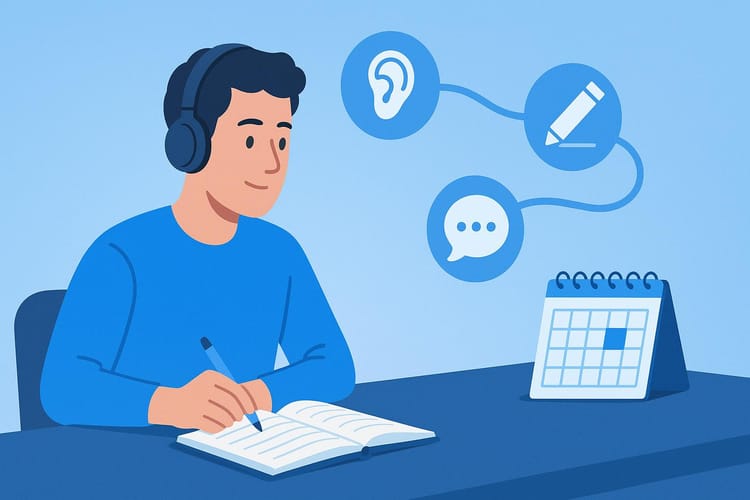
The 20-minute beginner loop
Minutes 1 to 5: listen or read once for the main idea
Minutes 6 to 10: replay and notice repeated phrases
Minutes 11 to 15: check transcript, subtitles, or notes
Minutes 16 to 20: replay without stopping
That is enough. Seriously. If you do that consistently, your comprehension will move.
If you want a slightly more ambitious version, add one tiny output step after the input:
- say three sentences out loud
- summarize the clip in simple words
- reuse one phrase in your own example
That last piece matters because it starts moving input toward usable language.
Common mistakes with comprehensible input for beginners
This is where people sabotage a good method.
Mistake 1: confusing native content with useful content
Native content is not automatically good for beginners. It is only useful when you can actually follow enough of it to learn from it.
Mistake 2: refusing all support
Some learners act like subtitles, transcripts, or pictures are cheating. That is nonsense. Support tools are scaffolding. Use them, then reduce them gradually.
Mistake 3: jumping across too many resources
One day anime clips, next day grammar TikTok, next day business podcasts, next day some app you forgot to cancel. That is not a system. That is noise.
Mistake 4: tracking every unknown word
You do not need to stop for everything. If the overall message is clear, keep going. The point is understanding meaning, not turning every session into a forensic investigation.
Mistake 5: hiding from speaking forever
Input is foundational, but if you use comprehensible input as a permanent excuse to avoid output, that becomes its own trap. Beginners do not need perfect speech. They need early, low-pressure attempts.
How to know your comprehensible input is working
You probably will not notice progress day to day. That is normal. What changes first is not dramatic fluency. It is friction.
You will notice things like:
- repeated phrases start sounding familiar instead of random
- you stop needing to translate every small chunk
- short videos feel slower and clearer
- you can predict what comes next in common patterns
- beginner conversations stop feeling like total chaos
That is real progress even if it does not feel glamorous.
One of the best signs is this: material that used to feel impossible starts feeling merely annoying, then manageable, then easy. That is how the ladder works.
When to level up from comprehensible input for beginners
You level up when the current material becomes too easy to produce meaningful stretch. That does not mean abandoning it completely. It means nudging the difficulty.
Try moving from:
- learner podcasts to slower native podcasts
- graded readers to simple native articles
- beginner videos to intermediate explainers
- scripted dialogues to unscripted interviews
The trick is gradual escalation. Do not go from toddler content to courtroom drama just because you got cocky on a Tuesday.
The no-BS rule for comprehensible input for beginners
If you remember one thing, make it this: comprehensible input for beginners should feel understandable, repeatable, and sustainable.
Not impressive. Not punishing. Not optimized into oblivion.
Pick input you can actually return to tomorrow. Use support tools without shame. Repeat more than your ego wants to. Then let the language pile up in your head the way languages are supposed to: through repeated contact with meaningful stuff.
If your current study routine feels like a lot of effort for not much real understanding, stop making it harder than it needs to be. Start smaller. Make it clearer. Then stack wins until the language stops sounding like static.
What is one source you could use this week as real comprehensible input for beginners instead of pretending that your favorite chaotic native show is “good exposure”?