Language Shadowing Technique in 2026: How to Build a 15-Minute Routine That Fixes Listening and Pronunciation
Language Shadowing Technique in 2026: How to Build a 15-Minute Routine That Fixes Listening and Pronunciation
If language shadowing technique is the phrase you keep seeing lately, there is a reason. A lot of learners have finally realized that passive listening is comfortable, pronunciation drills can get weirdly isolated, and “just consume more content” stops working once your ear and mouth fall out of sync. The language shadowing technique solves that by forcing listening, timing, pronunciation, and recall to happen in the same rep instead of in four separate study activities that never properly meet.
Used well, the language shadowing technique is one of the cleanest ways to improve spoken rhythm, sharpen listening under speed, and stop sounding like someone who only knows the language from textbooks and subtitles. Used badly, it becomes one more fake-hard routine where you mumble behind a podcast for ten minutes and call it progress. The difference comes down to how you choose material, how you pace the rep, and whether shadowing actually connects to real output.
We have already covered retrieval practice for language learning, intermediate plateau resets, AI pronunciation practice for self-study, and the bigger problem of building a language maintenance routine after B1. The language shadowing technique fits right in the middle of those systems because it gives you one compact way to train perception and production together.
What the Language Shadowing Technique Actually Is
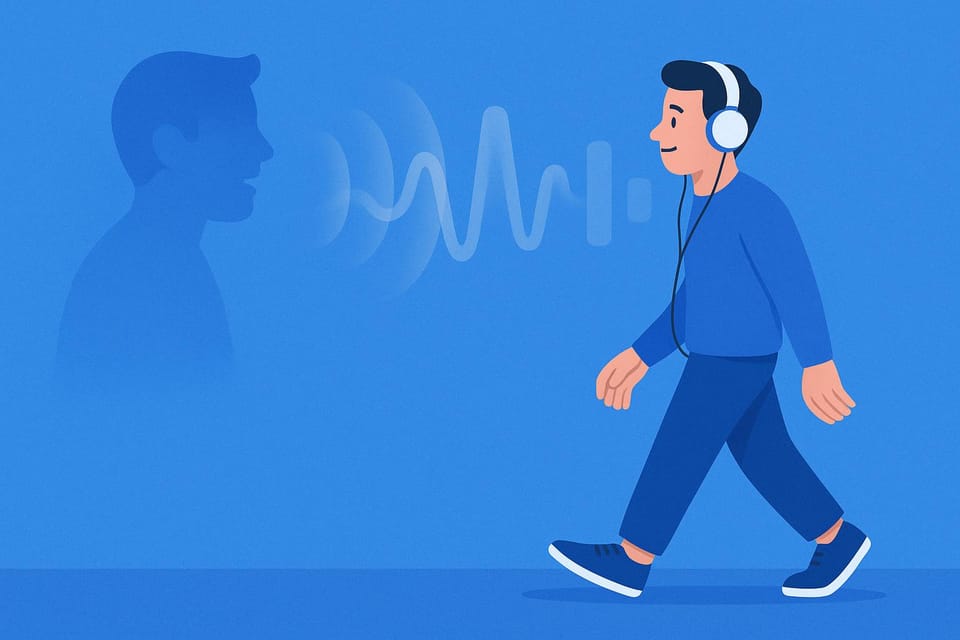
The language shadowing technique is simple in theory. You listen to short audio in your target language and repeat it almost immediately, trying to match the speaker’s rhythm, stress, phrasing, and timing as closely as possible. Not after a long pause. Not after translating it. Right on its heels.
That tiny delay is what makes the drill useful. You are not just repeating words. You are training your brain to track sound, chunk meaning, and move your mouth under pressure.
That is also why shadowing keeps showing up across competitor guides like FluentU’s introduction to the shadowing technique and Mezzoguild’s breakdown of language shadowing. The pitch is always similar: shadowing helps learners sound more natural because it trains language as moving speech, not as isolated items.
The more interesting part is that research has kept taking the method seriously. A recent systematic review of shadowing in second-language learning shows how often it is studied as a bridge between listening and speaking, and a study on training through shadowing and reading aloud found measurable gains connected to oral reading fluency and processing.
So no, shadowing is not magic. But it is not gimmicky nonsense either.
Why the Language Shadowing Technique Works Better Than Passive Listening
Passive listening gives you contact. The language shadowing technique gives you friction.
That friction matters because most learners do one of two dumb things:
- they listen without trying to say anything
- they speak without matching real native rhythm
Shadowing closes that gap.
It forces attention to sound details
When you have to echo speech right away, you notice things you normally let slide:
- swallowed syllables
- linking between words
- stress shifts
- sentence melody
- how speakers reduce common phrases
That is miles better than hearing a sentence, vaguely understanding it, and moving on like the job is done.
It trains timing, not just correctness
A lot of pronunciation work focuses on getting the sounds “right.” Fine. But real speech is not just sound accuracy. It is timing. It is how fast a phrase leaves your mouth, where it relaxes, and where the energy lands.
The language shadowing technique works because it trains that timing directly. You do not get infinite planning space. You have to ride the sentence as it happens.
It exposes where your listening falls apart
Shadowing is brutally honest. If a sentence falls apart in your mouth, one of a few things is usually happening:
- you did not hear the chunk clearly
- you know the words on paper but not in speech
- your mouth cannot execute the sequence yet
- the audio is too fast for your current level
That is useful information. It tells you exactly where your so-called comprehension is still soft.
It helps move phrases into active use
This is where the method becomes more than a pronunciation exercise. Repeatedly shadowing high-frequency phrases makes them easier to retrieve later in conversation. That links neatly to retrieval practice: you are strengthening not just recognition, but access.
The Best Language Shadowing Technique Routine for Busy Adults
Most people screw this up by choosing material that is either too hard, too long, or too boring. Then they quit and blame the method.
A better language shadowing technique routine is short, repeatable, and slightly uncomfortable without becoming chaos.
Step 1: Choose audio that is clear but not robotic
Use short clips with natural speech:
- podcast excerpts
- interview segments
- YouTube intros or explanations
- dialogue from learner-friendly shows
- voice notes from a tutor or exchange partner
Avoid audio that is:
- packed with slang you cannot yet parse
- acted so dramatically that imitation becomes goofy
- so easy that you can parrot it without attention
- so hard that every rep becomes static
The sweet spot is roughly 70 to 90 seconds of speech you can mostly follow, even if you cannot reproduce it smoothly yet.
Step 2: Do a listen-first pass
Before shadowing, listen once or twice without speaking. Your job is to catch the gist and identify the moving parts.
Ask:
- where do phrases begin and end?
- which words get reduced?
- what sounds glued together?
- where does the speaker speed up or soften?
If you jump in too soon, you risk copying noise instead of speech.
Step 3: Shadow in small chunks
Do not try to shadow a three-minute clip like a maniac. Break it into lines or short chunks.
A good sequence looks like this:
- listen to one sentence
- shadow it once while reading a transcript if needed
- shadow it again without looking
- move to the next sentence
- connect two or three sentences together
That is how you keep the language shadowing technique clean instead of sloppy.
Step 4: Record one rep
You do not need to record every single pass, but you should record one. Otherwise you are just trusting your own ego, and your ego is not a reliable audio engineer.
Listen back for:
- rushed endings
- flat intonation
- dropped function words
- hesitation before common chunks
- misheard sounds
This is exactly where AI pronunciation practice can help. Use feedback to spot patterns, not to obsess over perfection.
Step 5: Reuse the language in your own words
This step is non-negotiable.
After shadowing, say or write a short variation using the same structure. If the speaker says, “I used to think that was the hardest part,” you produce something like, “I used to think listening was the hardest part.”
That stops the language shadowing technique from becoming pure mimicry. You need transfer, not karaoke.
How the Language Shadowing Technique Helps at Different Levels
The method changes depending on where you are.
Beginner-leaning learners
Use very short clips, slower audio, and transcripts. Focus on catching clean word boundaries and basic rhythm. Do not chase speed yet.
Intermediate learners
This is where the language shadowing technique really starts paying off. Intermediates often understand enough to follow content but still speak in choppy, over-assembled sentences. Shadowing smooths that out.
It also helps if you are stuck in the exact mess we described in our guide to the intermediate plateau. The issue is often not lack of knowledge. It is poor transfer under real speed.
Advanced learners
Advanced learners should use shadowing for accent tuning, speed adaptation, and topic-specific fluency. Think interview clips, opinion pieces, or domain-specific conversation, not sanitized textbook dialogue.
Where the Language Shadowing Technique Goes Wrong
The method is good. Learners still manage to butcher it.
Mistake 1: Shadowing material that is too hard
If every sentence is a crash scene, the audio is above your working level. Scale it down.
Mistake 2: Prioritizing volume over quality
Ten ugly reps do less than three focused ones. Clean attention beats heroic noise.
Mistake 3: Never checking comprehension
You do not need to translate every line, but you do need to know what you are saying. Otherwise the language shadowing technique turns into mouth gymnastics.
Mistake 4: Treating shadowing as the whole plan
Shadowing is a tool, not a complete language system. It works best when it feeds a larger weekly routine. That is why it fits so naturally into a language maintenance routine after B1: one anchor for listening, one for retrieval, one for output, one for review.
A 15-Minute Language Shadowing Technique Routine You Can Actually Keep
If you want a dead simple version, use this.
Minutes 1 to 2
Choose one short clip and listen for gist.
Minutes 3 to 6
Shadow sentence by sentence with transcript support.
Minutes 7 to 10
Shadow again without looking whenever possible.
Minutes 11 to 13
Record one pass and compare it to the source.
Minutes 14 to 15
Reuse two or three phrases in your own mini-summary.
That is enough. Seriously. You do not need a ninety-minute temple ritual. You need repeated clean reps.
My Verdict on the Language Shadowing Technique in 2026
The language shadowing technique is worth your time because it fixes one of the most common weak spots in self-study: the gap between hearing language and being able to move with it.
Use it if you want to:
- sound less stiff
- hear connected speech more clearly
- build better rhythm and stress
- turn passive listening into active training
- keep your spoken language from getting rusty
Do not use it as an excuse to avoid real output. Shadowing should make conversation easier, not replace conversation forever.
That is the whole point. You are training your ear and mouth to cooperate under speed, so that when real speech shows up, you are not standing there like a busted GPS recalculating every clause.
If you tried the language shadowing technique this week, what kind of audio would make the best first clip for your level right now?