Language Immersion at Home in 2026: How to Build a Real Input-and-Output Environment Without Moving Abroad
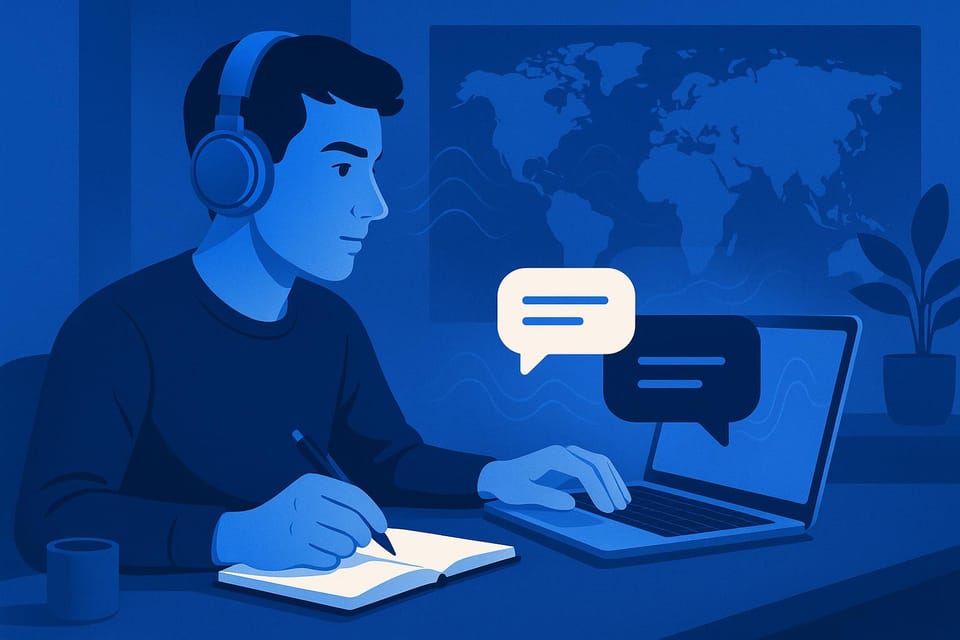
If language immersion at home sounds like a watered-down substitute for moving abroad, that is because most people build it in the laziest possible way. They change their phone language, watch one Netflix show, slap sticky notes on the fridge, and call it immersion. That is not immersion. That is decoration. Real language immersion at home works when you redesign your environment so the language keeps showing up in useful forms, at useful moments, and then forces you to do something with it.
That matters even more in 2026 because learners have more access than ever and more structure than ever, but a lot of that access stays passive. You can drown in podcasts, AI chats, subtitles, flashcards, and browser tabs without ever building the friction that makes a language usable. That is why this topic sits so nicely next to our pieces on the language shadowing technique, language maintenance after B1, AI roleplay for language learning, and language learning progress journals. The point is not to make your room look multilingual. The point is to make your habits harder to dodge.
Why language immersion at home still works in 2026
A lot of learners assume immersion only counts if you physically relocate. That is nonsense. Relocation changes the environment fast, but the underlying mechanism is still repeated contact, meaningful cues, and pressure to retrieve. Those mechanics can absolutely be built at home if you stop thinking like a tourist and start thinking like a system designer.
Articles from GoAbroad, StoryLearning, and Ling all point toward the same broad truth: immersion is less about romance and more about density. If the language keeps showing up across listening, reading, speaking, and tiny life admin tasks, it starts feeling normal instead of special.
That normalization matters. A language you only meet inside “study time” stays boxed off. A language you meet while cooking, commuting, exercising, planning, and messaging starts invading your automatic routines. That is when recall gets faster.
Language immersion at home fails when the setup is too passive
Most bad home-immersion advice commits the same sin. It overweights exposure and underweights response.
People are told to:
- switch device settings
- play background audio all day
- label household objects
- watch more content
- scroll target-language social media
None of those are useless. But on their own, they can become passive theater.
If you want language immersion at home to do real work, every passive input layer needs a paired output or retrieval layer. If you listen to a short clip, shadow it. If you read a thread, summarize it aloud. If you learn a phrase, use it in a voice note. If you change your phone language, stop and say the relevant menu items out loud instead of just clicking through on autopilot.
That is also why the ACTFL proficiency framework still matters. Proficiency is not measured by how surrounded you feel. It is measured by what you can actually do.
How to build language immersion at home without turning your life into cosplay
This is the part people screw up by overengineering it. You do not need a fake French café corner in your apartment. You need repeated language cues linked to real behaviors.
1. Pick three daily zones, not your whole life
Choose three areas where the language will reliably appear every day:
- morning setup
- work breaks or lunch
- evening wind-down
That is enough. If you try to convert your entire day in one shot, you will last about three days before reverting to English and pretending you are “busy.”
2. Assign one skill to each zone
A clean setup looks like this:
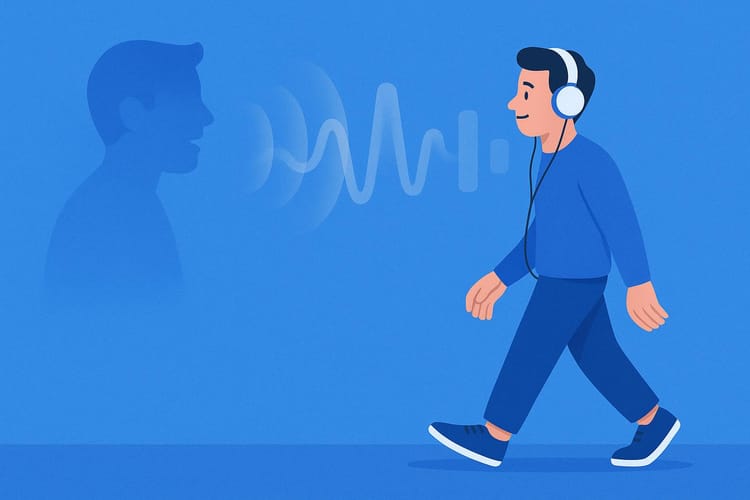
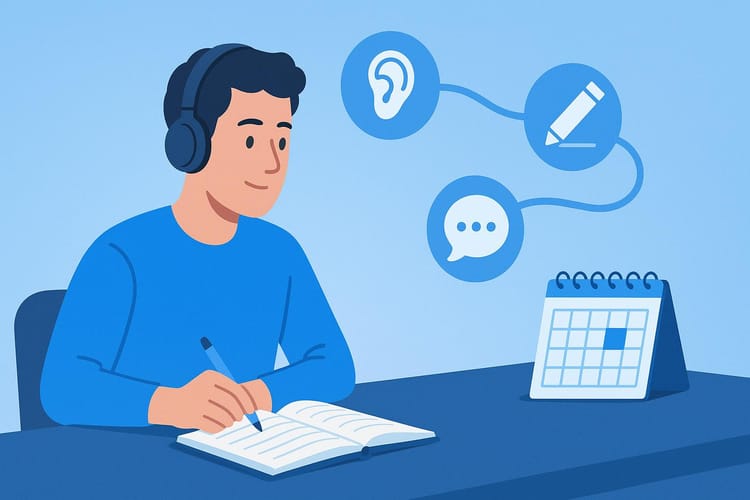
- Morning: short listening plus shadowing
- Midday: reading plus one written summary
- Evening: speaking or roleplay
This keeps your home immersion balanced instead of becoming a giant pile of input. It also plays well with the 15-minute structure from our language shadowing routine. Shadowing is especially useful because it forces pronunciation, timing, and listening to work together instead of sitting in separate boxes.
3. Make objects trigger actions, not labels
Sticky notes are fine if they do more than name a thing. Do not just label “mirror.” Put a mini prompt on the mirror that forces speech:
- “Describe how you look today.”
- “Say three plans for tonight.”
- “Retell yesterday in 20 seconds.”
Now the object is a cue for production, not décor.
4. Use audio everywhere, but in short loops
Do not run eight hours of target-language noise and call it immersive. Use small loops you can actually engage with:
- a 60-second news clip
- a short dialogue
- a podcast excerpt
- one AI voice exchange
The Studies in Second Language Acquisition ecosystem has been documenting for years that quantity matters, sure, but attention matters too. Focused loops beat wallpaper audio.
A practical language immersion at home routine for busy adults
If you want language immersion at home to survive real life, it needs to fit inside a normal human schedule.
Morning: 12 minutes
- Play one short clip.
- Listen once for gist.
- Listen again and shadow line by line.
- Say one original sentence using the same pattern.
That last step is the difference between practice and mimicry.
Midday: 10 minutes
- Read one short article, post, or thread.
- Pull out five useful words or chunks.
- Write a three-sentence summary from memory.
This is also a good place to use the accountability angle from our progress journal guide. A journal is not glamorous, but it catches the drift between “I touched the language” and “I actually retained something.”
Evening: 15 minutes
- Do a speaking task based on the day’s input.
- Use AI roleplay, a tutor, a language partner, or a recorded voice memo.
- Reuse at least three phrases from earlier.
That connects nicely with our AI roleplay article. AI is decent here if you use it as pressure, not as a hand-holding machine that feeds you perfect lines before you have tried anything yourself.
Language immersion at home should change by level
One of the dumbest mistakes in home immersion is pretending beginners, intermediates, and advanced learners should do the same thing.
Beginner
Keep the environment narrow. Use survival phrases, familiar topics, and highly repetitive content. You need confidence through repetition, not heroic complexity.
Intermediate
This is where language immersion at home gets really powerful. You already know enough to understand a lot, but you still need more speed and less hesitation. Focus on:
- summarizing without notes
- shadowing slightly harder material
- retelling your day
- handling follow-up questions
That is why it pairs so well with language maintenance after B1. Intermediate learners do not need prettier beginner routines. They need better transfer into real usage.
Advanced
Now the home setup should push nuance. Opinion pieces, interviews, live conversations, and topic-specific vocabulary start mattering more than basic repetition.
The biggest mistakes people make with language immersion at home
Let’s kill a few of the classics.
Mistake 1: confusing aesthetics with immersion
If your desk looks multilingual but your mouth stays shut, congrats, you built a themed workspace.
Mistake 2: consuming way more than you retrieve
Recognition feels good. Retrieval builds skill. Different game.
Mistake 3: making the setup too fragile
If your system only works when everything is quiet and perfect, it is not a system. It is a mood.
Mistake 4: never measuring what improves
Use a weekly check. Ask:
- Am I responding faster?
- Am I understanding more without subtitles?
- Am I reusing yesterday’s phrases today?
- Am I less hesitant in familiar topics?
If the answer stays no, the setup needs more production and less comfort.
What to include in a language immersion at home environment
A sane home setup usually includes five layers:
- Short-form listening you can replay and shadow
- Readable content slightly above your comfort level
- Speaking prompts attached to real routines
- A correction loop through AI, tutor feedback, or self-review
- A tracking habit that records actual reuse
That is enough to make the environment feel alive without becoming a clown show. You do not need to simulate another country. You need to create regular contact plus regular response.
My verdict on language immersion at home
Language immersion at home works when it stops being a vibe and starts being infrastructure. That means repeated cues, active response, level-appropriate tasks, and just enough friction to expose your weak spots without blowing up your schedule.
If you do it right, home stops being the place where your language goals go to die. It becomes the place where your language finally stops feeling separate from your actual life.
So, which three places in your day are you going to convert first, and what will the language force you to do there besides just sit there and look impressive?